
Moving a business from a free zone setup into a mainland operating model is not just a licensing change. It is also a finance and compliance reset. Once the business structure changes, the accounting function often needs to change with it. That is why mainland company accounting requirements following a free zone transfer deserve careful attention. Dubai mainland businesses will sit within the DET or Invest in Dubai setup environment. Whereas UAE tax obligations. Like VAT and Corporate Tax continue to apply. Based on the business’s real activity. Registration status. Also tax profile.
In Dubai terms. This will matter for businesses in Business Bay. Deira. Sheikh Zayed Road. Also other commercial districts. Where companies shift from a zone-based structure into a broader mainland operating model. To serve the wider UAE market. This transition happens through restructuring. Permit-based operating changes. Expansion. Or a more direct mainland registration route. This depends on the authority path. Also business facts. Once the business starts operating as a mainland company. The accounting team needs to revisit bookkeeping. Invoicing. VAT logic. Tax records and internal controls.
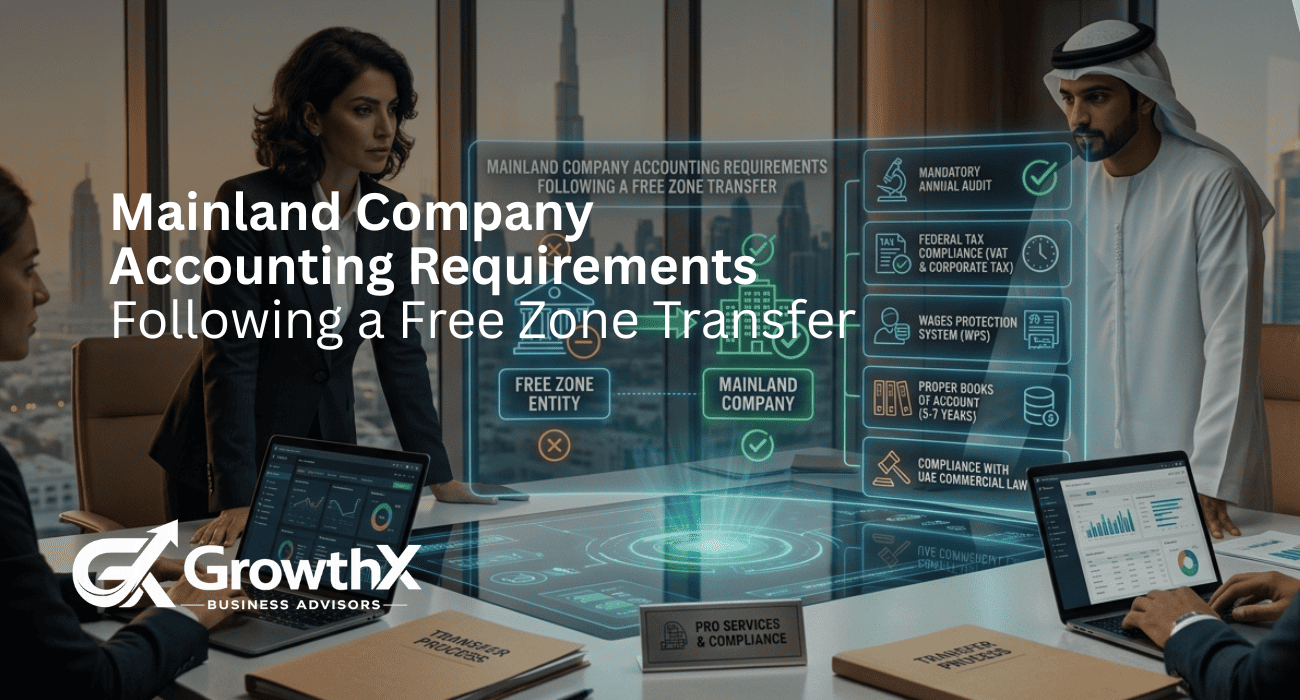
What a Free Zone to Mainland Transition Means in Practical Terms
A “free zone transfer” does not always mean one identical legal process. In practice, businesses may redomicile, restructure, create a new mainland entity, or shift operating activity into a mainland model while keeping some free zone links. Because the mechanics can differ, founders should avoid assuming that the accounting treatment is automatic. What matters most is the post-transition reality: which entity is now invoicing, where the activity is performed, which registrations apply, and how the books support the new structure. That is a practical inference from the separate mainland and tax frameworks shown by Dubai and UAE official sources. Get details on Accounting & Bookkeeping Service Provider in Dubai.
Why Accounting Requirements Change After the Move
Once a business shifts into a mainland operating structure, its accounting function must reflect the new legal and commercial reality. This can affect revenue recognition, expense allocation, payroll workflows, bank-account mapping, VAT treatment, and even how management reports are built. The UAE’s tax environment also requires businesses to maintain documents and records that support filings and tax positions, so a post-transfer business cannot rely on legacy books that no longer match how the company operates.
Free Zone vs Mainland Accounting Focus
|
Area |
Free Zone Focus |
Mainland Focus After Transition |
|
Entity logic |
Zone-based setup and internal reporting |
Mainland operating model and onshore activity support |
|
Invoice workflow |
Legacy free zone invoicing patterns |
Updated mainland invoicing and document flow |
|
Tax review |
Free zone profile and related checks |
Mainland VAT and Corporate Tax review |
|
Controls |
Early-stage or lighter processes in some firms |
Stronger audit-ready controls and reconciliations |
This comparison is a practical accounting interpretation of the UAE mainland, VAT, and Corporate Tax environment.
Bookkeeping, Invoicing, VAT, and Corporate Tax Review
The first thing a business should review is whether its bookkeeping still matches the entity now carrying on the activity. If the mainland company is issuing invoices, collecting revenue, or hiring staff, then the books must reflect that clearly. A VAT review is also essential. VAT obligations depend on the actual registration and taxable activity of the business, and the Federal Tax Authority continues to provide the official guides and references businesses should use to understand those obligations.
Corporate Tax also needs fresh attention after the shift. The FTA’s Corporate Tax guidance and return materials show that tax compliance is now firmly operational, which means businesses need defensible records, clear documentation, and a tax file that reflects the current structure rather than an outdated one. Looking for a Auditing Services in Dubai & UAE?
Why Ledger Cleanup and Chart-of-Accounts Updates Matter
A transfer or transition can leave behind messy ledgers. Common issues include:
- revenue posted under the wrong entity
- old customer or supplier names still active
- free zone expense codes that no longer fit the mainland structure
- payroll and bank transactions not aligned to the operating company
This is why businesses require a chart-of-accounts review. Opening-balance check. Also transaction reclassification. After the move.
Post-Transfer Accounting Checklist
|
Checkpoint |
Why It Matters |
|
Opening balances reviewed |
Prevents inaccurate carry-forward figures |
|
Chart of accounts updated |
Aligns books with the mainland structure |
|
VAT positions reassessed |
Ensures filings match the new operating reality |
|
Corporate Tax records reviewed |
Supports the tax position under the new setup |
|
Bank, payroll, and vendor workflows updated |
Keeps day-to-day accounting consistent |
Common Mistakes Businesses Make After Transfer
The biggest mistakes usually come from assuming the transfer is complete once the licence is issued. In reality, finance teams often forget to:
- update invoice templates and supplier records
- review VAT treatment on current transactions
- clean up opening balances and historical mapping
- reassess Corporate Tax exposure
- keep supporting records in a way that matches the mainland entity
Those issues can create audit stress later because UAE tax compliance depends heavily on documentary support and accurate books. Get details on Bank Account Support Services in Dubai & UAE.
Why Professional Support Matters
Post-transfer accounting is not just bookkeeping. It is a combination of finance cleanup, document control, tax review, and process redesign. A business that gets this right can move into the mainland smoothly. A business that ignores it may end up with filing errors, weak reconciliations, and records that do not support its current structure.
Why GrowthX
GrowthX can help businesses moving out of a free zone operating model build cleaner books, review VAT and Corporate Tax positions, update finance processes, and create stronger post-transition controls for the mainland environment.
Related Articles:
» Visa & PRO Services in Dubai & UAE
» Company Liquidation & De-Registration Services in Dubai & UAE
» AML Compliance Services in Dubai & UAE
» Trademark & Product Registration/Approval Service in Dubai & UAE
» Attestation & Legalization Service in Dubai & UAE
Move into the Mainland with Clean Books
If your company is shifting from a free zone structure into a mainland operating model, now is the right time to review the books before small errors become larger compliance issues. GrowthX can help you make the transition with stronger accounting, cleaner records, and better financial control.
FAQs: Mainland Company Accounting Requirements Following a Free Zone Transfer
The books usually need to be reviewed so they match the new mainland operating reality, including invoicing, records, and tax treatment.
Yes. UAE businesses need proper records and supporting documents for compliance and tax purposes.
Yes. VAT treatment should be reassessed because the operating model, entity, and transaction flow may have changed.
Yes. Corporate Tax compliance should reflect the actual current structure and records.
Because inaccurate balances can distort the books from the first day of mainland operations.
Often yes, especially if the old structure no longer matches the mainland company’s operations.
Not always. Invoice workflows often need updating to match the mainland entity and its records.
Yes. Dubai mainland setup sits within the official DET and Invest in Dubai environment.
Because businesses often change operations faster than they change their finance controls.
Yes. The FTA provides official VAT guides, clarifications, and references.
Tax and compliance reviews will depend on records. That supports the business’s current structure. Also transactions.
Because post-transfer accounting needs more than bookkeeping alone. It needs cleanup, tax review, and process alignment.