
Bookkeeping will no longer be an internal finance task. For businesses in Dubai. It is now a core compliance function. As the UAE moves closer to its eInvoicing rollout, companies need cleaner records, stronger invoice controls, and better source-document discipline. That is why audit-ready bookkeeping in Dubai, UAE matters more than ever. The Ministry of Finance’s 2026 UAE Electronic Invoicing Guidelines. This mentions the VAT framework was updated. To support the eInvoicing system. With phased implementation starting from 1 July 2026. For the pilot and mandatory rollout beginning in 2027. Based on revenue thresholds. UAE Electronic Invoicing Guidelines.
In Dubai, this shift is especially relevant for new mainland businesses in Business Bay, fast-moving service firms in Sheikh Zayed Road corridors, growing e-commerce brands, and free zone startups that are still building their finance function. Most of these businesses began with light bookkeeping. Manual invoices. Also founder-led admin. But the current UAE VAT environment will expect something more structured. The Ministry of Finance announced VAT law amendments. Effective from January 2026. This includes relief from issuing self-invoices. When applying the reverse charge mechanism. Whereas requiring businesses to retain supporting documents. For supply transactions.
Why Audit-Ready Bookkeeping Matters Now
Bookkeeping will be used to be seen as a back-office function. Today, it is a front-line defence against filing errors, audit stress, and weak VAT evidence. As eInvoicing becomes a real operating framework in the UAE, businesses need records that can stand up to both tax review and internal scrutiny. The Ministry’s eInvoicing page makes clear that an eInvoice is not just a PDF or scanned copy. It is a structured invoice data file issued, exchanged, and reported electronically.
That changes expectations. Businesses now need:
- clear source documents
- accurate invoice classification
- reliable reconciliations
- better control over transaction evidence
What the Removal of VAT Self-Invoicing Means in Practice
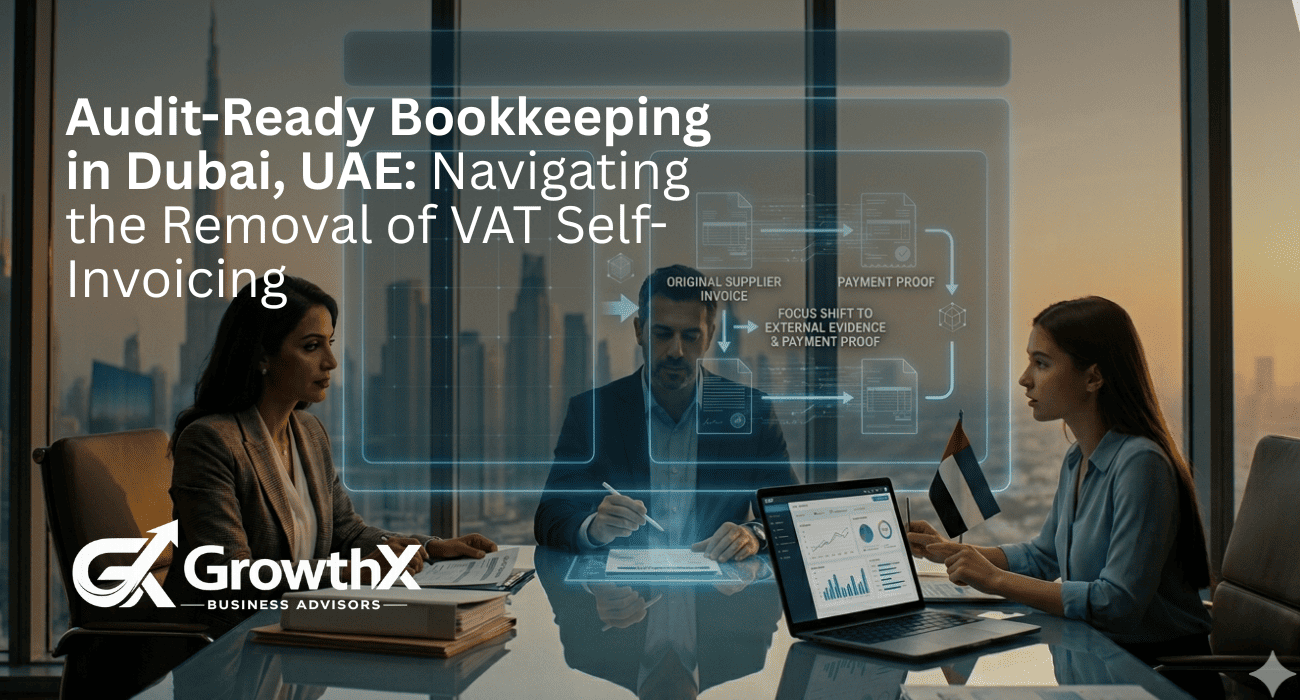
This topic needs careful wording. The UAE has not removed invoicing rules altogether. But the Ministry of Finance mentions. That taxable persons are relieved from issuing self-invoices. When applying the reverse charge mechanism. Whereas still needing to retain supporting documents. That is related to the supply. This means the compliance focus shifts. From producing internal substitute invoices. To maintain strong documentary evidence. Also accurate bookkeeping support.
For businesses, that means one thing: sloppy records are now even riskier. Get details on Auditing Services in Dubai & UAE.
Old Habit vs Audit-Ready Workflow
| Area | Older Weak Practice | Audit-Ready Practice |
| Reverse-charge evidence | Relying on internal assumptions | Keeping full supporting documents |
| Invoice storage | PDFs scattered in email folders | Structured digital storage and indexing |
| VAT treatment | Manual guesswork | Clear transaction classification |
| Bookkeeping review | Done only at filing time | Ongoing monthly reconciliations |
How the Current VAT Environment Changes Bookkeeping Expectations
Businesses should now think beyond “Did we file on time?” A better question is “Can we support every figure in the return?”
The FTA’s VAT references page continues to position official guidance, clarifications, and references as central to understanding tax obligations. The eInvoicing guidelines. This shows that the UAE is moving toward a structured transaction-reporting model. Together, these developments will raise the bar for bookkeeping quality. Looking for a Accounting & Bookkeeping Service Provider in Dubai, UAE?
Areas that need stronger control
- input VAT vs output VAT accuracy
- supplier and customer invoice matching
- credit note handling
- transaction coding
- document retention
Common Bookkeeping Risks for New Businesses
New setups in Dubai often face the same problems. They grow quickly, yet their records lag behind.
Most common pitfalls
- posting expenses without valid source documents
- misclassifying zero-rated, exempt, and standard-rated transactions
- claiming input VAT too loosely
- relying on spreadsheets instead of controlled workflows
- filing VAT before reconciling sales, purchases, and bank records
Bookkeeping Risk vs Practical Fix
| Risk | Practical Fix |
| Missing supplier evidence | Collect and store supporting documents before posting |
| Wrong VAT coding | Use a standard VAT mapping chart |
| Weak month-end controls | Reconcile monthly, not just before return filing |
| Manual invoice handling | Prepare for structured eInvoicing workflows |
| Founder-led finance chaos | Assign accountability to a finance lead or advisor |
Why eInvoicing Readiness Now Matters
Though full mandatory eInvoicing is phased from 2027. Businesses must not wait until the last minute. The 2026 guidelines will allow voluntary implementation from 1 July 2026. Also the mandatory schedule starts with businesses. This generates AED 50 million or more. In annual revenue by 1 January 2027. This is followed by businesses. Below that threshold by 1 July 2027.
That means businesses should already improve:
- chart-of-accounts discipline
- invoice data quality
- customer and supplier master data
- document workflows
- audit trails
A Simple Readiness Checklist
| Checklist Item | Why It Helps |
| Monthly VAT reconciliation | Reduces filing surprises |
| Clean invoice archive | Improves audit evidence |
| Clear VAT coding rules | Reduces classification mistakes |
| Strong source-document retention | Supports reverse-charge and supply records |
| System readiness review | Helps future eInvoicing adoption |
Why Professional Support Matters
Most bookkeeping issues do not begin with bad intent. They begin with rushed admin, weak systems, and delayed reviews. Professional support helps businesses build finance processes that are not only accurate but also defensible. In the current UAE VAT environment, that is a major difference. Get details on Bank Account Support Services in Dubai, UAE.
Why GrowthX
GrowthX will help businesses in Dubai and across the UAE. To build stronger bookkeeping controls. Improve VAT discipline. Also prepare for the practical realities of eInvoicing. This means better reconciliations. Cleaner records. Plus less stress when filing deadlines. Or audits approach.
Related Articles:
» Trademark & Product Registration/Approval Service in Dubai & UAE
» Corporate Structuring Service in Dubai, UAE
» VAT Registration & Returns Services in Dubai, UAE
» Golden Visa Advisory Service in Dubai, UAE
» Company Liquidation & De-Registration Services in Dubai, UAE
Strong CTA
When your business wants cleaner books. Stronger VAT support. Also a confident path into the UAE’s eInvoicing era. Now will be the right time to act. GrowthX will help you build audit-ready bookkeeping in Dubai, UAE. Before weak records become a bigger compliance problem.
FAQs: Audit-Ready Bookkeeping in Dubai, UAE
1. What is audit-ready bookkeeping in Dubai, UAE?This means maintaining records. Invoices. Reconciliations. Also supporting documents in a way that can support VAT filings. Plus withstand audit review.
2. Has the UAE changed its VAT rules because of eInvoicing?Yes. The Ministry of Finance’s 2026 eInvoicing guidelines mentions. That VAT legislation was updated. To support the rollout of the Electronic Invoicing System.
3. What is the UAE eInvoicing start date?The pilot begins on 1 July 2026. With mandatory rollout starting in 2027 in phases.
4. What counts as an eInvoice in the UAE?The Ministry says an eInvoice is structured invoice data issued, exchanged, and reported electronically. PDFs and scanned copies are not eInvoices.
5. What changed about VAT self-invoicing?The Ministry of Finance mentions. That taxable persons are relieved from issuing self-invoices. When applying the reverse charge mechanism. But they should still keep supporting documents.
6. Why does source-document accuracy matter more now?Because audit readiness now depends more heavily on real transaction evidence, not just internal posting logic.
7. When will eInvoicing become mandatory for larger businesses?Businesses with annual revenue of AED 50 million or more. The mandatory implementation starts on 1 January 2027.
8. When will eInvoicing become mandatory for smaller businesses?For businesses less than AED 50 million revenue, the current guideline sets 1 July 2027. As the mandatory implementation date.
9. Can businesses adopt eInvoicing voluntarily before it becomes mandatory?Yes. The Ministry mentions. The voluntary implementation will start from 1 July 2026.
10. What are the biggest bookkeeping mistakes UAE startups make?Common issues will include weak invoice storage. Poor VAT coding. Late reconciliations. Also incomplete supporting documents.
11. Is a PDF invoice enough for future UAE eInvoicing compliance?No. The Ministry mentions that PDFs and scanned copies will not be eInvoices.
12. Why should businesses improve bookkeeping before eInvoicing becomes mandatory?As cleaner data, better controls. Also stronger reconciliations will make VAT compliance. Also future eInvoicing adoption is much easier.