
To start a company in the UAE will be exciting. But choosing the wrong structure will limit your growth. Many founders jump in thinking all setups are similar. They’re not. The decision between Mainland vs Free Zone vs Offshore will shape everything. From market access to tax exposure. Scalability and banking approvals.
Do you choose wisely? Let us break it down in a practical way.
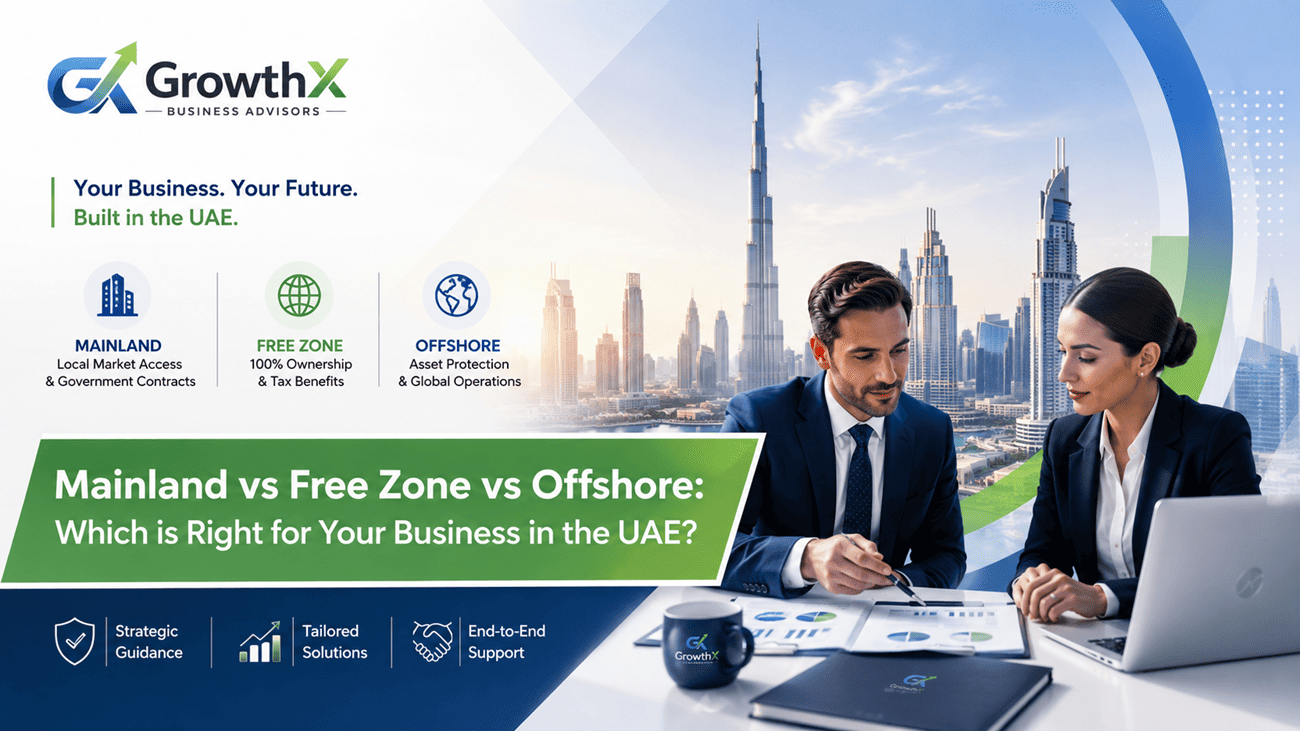
Understanding the UAE Business Landscape
The UAE will offer three primary company structures:
- Free Zone Company
- Mainland Company
- Offshore Company
Each one will serve a very different purpose. While they may look similar on paper, the real differences appear in where you can trade, how you scale, and what compliance looks like. Get details on Register a Company in Dubai.
What is a Mainland Company?
The Mainland business setup in UAE. This is licensed by the Department of Economic Development. This gives you unrestricted access to the UAE market.
Key Features:
- Trade anywhere in the UAE and globally
- Eligible for government contracts
- Requires a physical office
- Subject to 9% corporate tax (above threshold)
When your customers are in the UAE, the Mainland will be your playground.
As per the recent reforms, most sectors allow 100% foreign ownership. This removes earlier dependency on local sponsors. Looking to Register a Company in Dubai Mainland?
What is a Free Zone Company?
A Free Zone company in UAE. This will operate within designated economic zones like DMCC, DIFC or RAKEZ.
Key Features:
- Tax benefits (0% on qualifying income)
- 100% foreign ownership
- Faster setup and lower initial costs
- Limited direct trade in UAE mainland
Think of Free Zones as launchpads for global business. Particularly for startups and digital entrepreneurs.
When you want to sell directly in the UAE, you’ll need a local distributor or additional licensing. Get details on Register a Company in Dubai Free Zone.
What is an Offshore Company?
An Offshore company UAE is designed for international operations—not local business.
Key Features:
- No physical office required
- Zero corporate tax
- Strong asset protection & privacy
- Cannot operate within the UAE market
Offshore is ideal for:
- International trade
- Holding companies
- Wealth management structures
Here is the catch. You cannot do business inside the UAE with this structure.
Mainland vs Free Zone vs Offshore: Quick Comparison
|
Feature |
Mainland |
Free Zone |
Offshore |
|
Ownership |
100% (most sectors) |
100% |
100% |
|
Market Access |
UAE + Global |
Free Zone + Global |
Global only |
|
Corporate Tax |
9% applicable |
Often 0% (conditions apply) |
0% |
|
Office Requirement |
Mandatory |
Flexible (virtual allowed) |
Not required |
|
Visa Eligibility |
Yes |
Yes |
No |
|
Setup Cost |
Medium–High |
Low–Medium |
Low |
|
Best For |
Local market expansion |
Startups & exports |
Asset holding |
Key Decision Factors (What Actually Matters)
Let’s be honest—most founders choose based on cost. That is a mistake.
But focus on these critical decision drivers:
1. Market Access
When you prefer direct access to UAE customers → go Mainland
When you target global clients → Free Zone or Offshore
2. Tax Optimization
Free Zones and Offshore structures offer significant tax advantages. But they come with operational limits.
3. Business Activity
Retail? Construction? Government contracts? → Mainland
Consulting? E-commerce? SaaS? → Free Zone
Holding investments? → Offshore
4. Scalability
Mainland will offer fewer restrictions as you grow.
5. Cost vs Value
Free Zones will be cheaper. But Mainland will generate higher long-term revenue potential. Get details on Attestation & Legalization Service in Dubai.
Real-World Insight (What Entrepreneurs Say)
From actual founder discussions:
“Don’t decide based on cost alone—decide based on where your customers are.”
That’s the simplest and most accurate advice you’ll hear.
When Should You Choose Each?
Choose Mainland if:
- You plan to open a shop. Office. Or physical presence
- You want a full UAE market access
- You aim for the government. Or large contracts
Choose Free Zone if:
- You want tax efficiency
- You’re launching a startup. Or online business
- Your clients are international
Choose Offshore if:
- You run a global holding company
- You require asset protection
- You don’t need UAE operations
Common Mistakes to Avoid
- Choosing a Free Zone. While targeting local UAE customers
- Underestimating banking challenges
- Ignoring visa requirements
- Focusing only on setup cost. Instead of long-term ROI
Related Articles:
» Company Registration in Abu Dhabi
» Company Registration in Sharjah
» Company Registration in Ajman
» Company De-Registration Services in Dubai
» Accounting & Bookkeeping Service Provider in Dubai
Final Verdict: Which is Right for You?
There is no universal best option.
- Mainland = Maximum flexibility
- Free Zone = Efficiency and tax benefits
- Offshore = Strategic structuring
The right choice will depend on the business model. Not only your budget.
FAQs: Mainland vs Free Zone vs Offshore
Market access. Mainland allows direct UAE trade, while Free Zones restrict it.
Not directly—usually through a distributor or additional license.
Yes. But only for international business activities.
Free Zone setups are generally more affordable.
Not anymore for most activities—100% foreign ownership is allowed.
No, Offshore setups do not provide residency visas.
Free Zones are ideal. Due to lower cost and flexibility.
Often 0%. But only for qualifying income. Under regulations.
Yes. But it involves restructuring. Also additional costs.
Free Zone will be the best starting point.
Yes, a physical office is mandatory.
Free Zone or Offshore, depending on whether UAE presence is needed.